Carl Jung > Archetypes
What is The Self According The Self is the
archetype of the psychical totality or the wholeness. It is not identical to the ego, because it encompasses both the ego and the
unconscious. It is, therefore, a synthesis of the psychic totality - a union of opposites. The realization of the Self is the ultimate goal of the Jung has noticed that in some cases the cure of his patients' psychotherapy
does not interrupt with a better adaptation to reality, but continues from itself, aiming at a target that is not present in the ego. This target is the Self. The Self is actually a conjunction (union) of the
consciousness and unconscious. This conjunction is gradually accomplished by assimilating the contents of the unconscious with the help of dreams interpretation according to
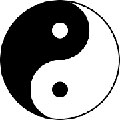
As symbol of the totality he appears as a circle, a square, a cross, a quadrangle of the circle or mandala .When it represents the unity of the opposites, it is a unified duality such as the Chinese T'ai Ch'i diagram which contains the opposites yin-yang, the hero and his opponent (demon, dragon), Faust and Mephistopheles etc. In this case the opposites are depicted as complementary forces or principles pointing to a superior unity. A figure often encountered in the dreams of the modern man, the Self is the half man-half animal character or, ethically, a monk and a profligate in the same time. The realization of the unity between the opposites on the personal level is precisely the purpose of the individuation process. But perhaps the most important aspect of the Self is its numinosity (capable to rise intense feelings of awe). According to Jung, the experience of the Self on the empirical, personal, level is similar to a religious revelation. The Self being, psychologically speaking, the equivalent of the concept of supreme deity or God. The identifying of the ego with the Self can lead to inflation or, in Jung's words, to "a sort of nebulous superman with a puffed-up ego". (On the Nature of the Psyche," CW 8, par. 430.) Jung about the Self The symbols of the process of individuation that appear in dreams are images of an archetypal nature which depict the centralizing process or the production of a new centre of personality. A general idea of this process may be got from my essay, "The Relations between the Ego and the Unconscious." For certain reasons mentioned there I call this centre the "self," which should be understood as the totality of the psyche. The self is not only the centre, but also the whole circumference which embraces both conscious and unconscious; it is the centre of this totality, just as the ego is the centre of consciousness. ( Psychology and Alchemy, Princeton University Press, 1993, par. 4.) Further resources:
<= Back to Archetypes |